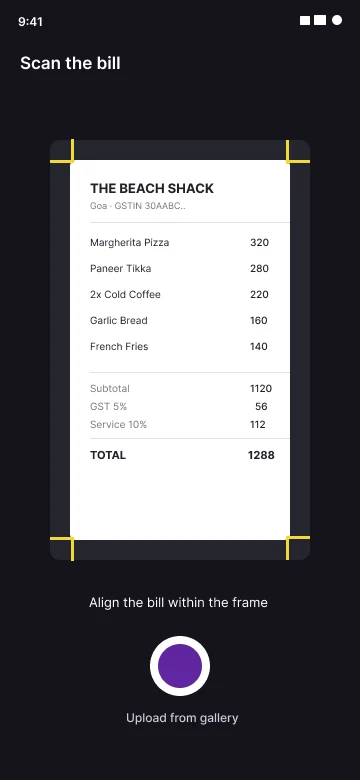
One person pays. Then the maths begins.
Four friends, one bill for ₹1,288: a pizza, paneer tikka, two cold coffees, garlic bread and fries, plus 5% GST and 10% service charge. One person pays. Now they have to work out who owes what.

Itemising, adding up and sharing out taxes by hand is real mental work, done at the end of a night out, under social pressure.
PhonePe's split flow today: 12 steps
"Equally" is easy. "Fairly" is a calculator.
I walked through the flow step by step and collected public reviews from LinkedIn, X, Reddit, YouTube and the Play Store. The pattern was clear: the app splits a total, but people want to split what they ate.

the 'split with friends' feature in GPay, Paytm, and PhonePe uses overall shares, percentages, or manual entries… focuses more on the exact items that they want to share
split-type features are hard to find in PhonePe, contrasting Paytm's clearer 'Split Bill' banner.
The job isn't "divide ₹1,288 by four". It's "make everyone pay for exactly what they had, without an argument."
Five frictions → one AI bet
Five frictions. One worth an AI.

A form can't read an arbitrary restaurant bill or understand plain language. That is where AI earns its cost and risk.
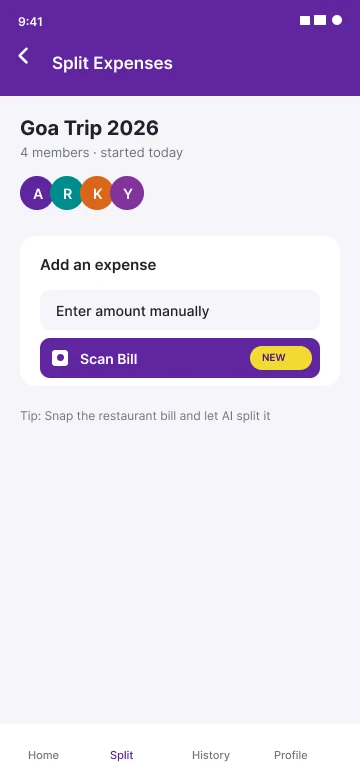
Smart Split: snap the bill.
"Scan Bill" sits right where the pain is, at the step where you'd otherwise type a total and divide it. Manual entry stays one tap away.
Features hidden in menus don't get used. The entry point belongs inside the flow, at the exact moment of friction.
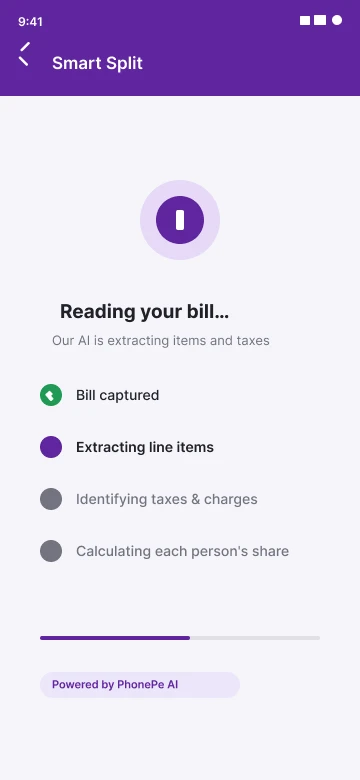
Read the bill. Understand who had what. Share the taxes.
- OCR reads every line: item, quantity, price, GST, service charge, total.
- Language AI maps plain words ("I had the pizza and one coke") to the right lines and people, or you just tap.
- Allocation logic shares GST and service charge in proportion to what each person ate.
Naming each step ("extracting items", "identifying taxes") makes the wait feel shorter and the result easier to trust.
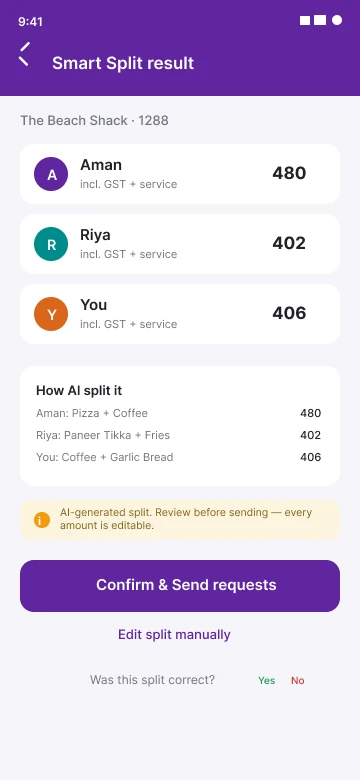
Taxes included. Every rupee explained.
Every amount stays editable, the screen says it is AI-generated, and there's a "Was this split correct?" check. (The prototype screen uses placeholder amounts; the try-it demo below does the exact maths.) The shares must add up to exactly ₹1,288, or nothing can be sent.
"How AI split it" shows the items behind each share. People pay faster when they can see what they're paying for.
Who had what? You decide.
This is the maths Smart Split does for you. Tap a name to change who had each item. GST (5%) and service charge (10%) are shared in proportion to what each person ate, and the shares must add up to exactly the bill.
The Goa bill · ₹1,288
Tap a name to reassign an item.
An equal split looks simple but quietly overcharges whoever ate least. Fairness is the whole promise of the feature, so the maths has to be exact.
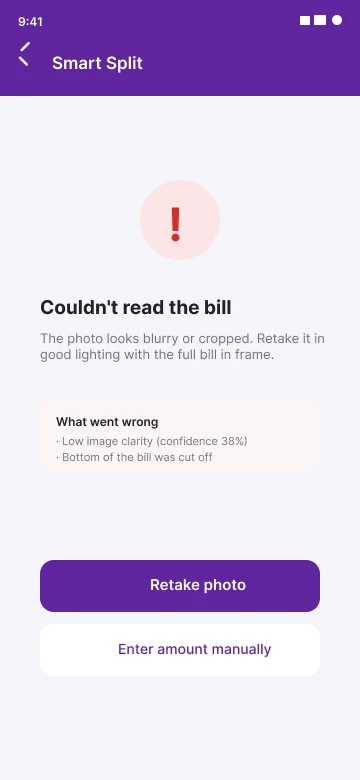
Say "I couldn't read this" instead of guessing.
A cropped, blurry bill gets a clear reason (confidence 38%, bottom of the bill cut off) and two ways forward: retake the photo or enter the amount by hand.
In payments, a fast wrong answer is far worse than a slower right one. When the AI is unsure, it must say so.
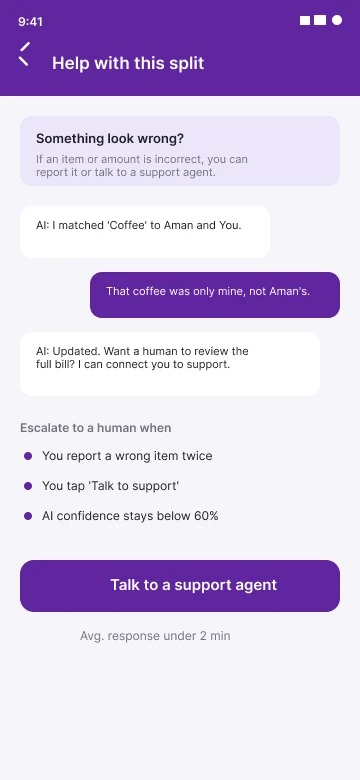
Easy to correct. Easy to reach a person.
If the AI gets an item wrong you just say so, and the split updates. A real support agent takes over if you report an item twice, tap "Talk to support", or the AI's confidence stays below 60%.
If the AI service is down, the app drops straight to the manual split with no waiting. The feature can fail without the flow failing.
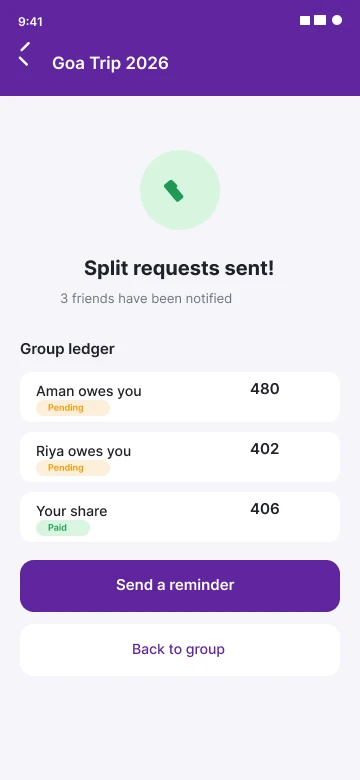
A request with the bill attached.
Receivers see the items behind their amount, not a bare "Pay ₹402". The bet: proof makes people pay faster, and the planner has to chase less.
Bhaisahab kis duniya mai ho notification se dost pese denge gaali dene par toh dete nhi hai"Brother, which world are you in? Friends won't pay because of a notification; they don't pay even when you swear at them."
Reminders alone don't fix awkwardness. An itemised, fair request removes the reason to argue.
North Star
Count money settled, not scans.
A scan only delivers value when the money actually comes back, so the North Star counts settled rupees. The guardrail I defended before the review panel: no split can be sent unless every share adds up exactly to the bill total. That adds a step when the AI is unsure, and I accepted the trade-off.
"Scans" goes up even when nobody pays. "₹ settled in 7 days" only goes up when the whole chain works.