← All case studies
Featured · Live product · Sarvodaya Ahinsa (Jain NGO)

Nobody came to watch a quiz, so I made everyone in the hall a player.

A live games platform I built for a Jain NGO, and the AI feature I shipped when the show data told me something I did not expect.

0→1Live dataAI · GeminiHuman-in-the-loop
My roleProduct manager & builder
WhenSept – Oct 2026
Users~150 players · 3 shows · 1–2 hosts
StatusLive · AI feature in Beta
Real words from players Thoughts, how it felt (illustrative) Me Real show data
STAGE … … … … 5 play · everyone else watches
Scene 1 · An evening event in Greater Noida
The problem

Five people play. Everyone else watches.

The NGO has spread Jain philosophy for over 15 years, and quiz games are one of the ways it teaches. But at every event the format was the same: 4–5 people on stage answered questions, and the rest of the hall sat and watched.

Someone in row 12I actually know this one… but nobody is asking me. Anyway, what's for dinner after this?
MePeople who aren't playing aren't learning. They talk among themselves, and the teaching gets lost. My goal became simple: no audience, only players.
🧠
Learning by doing

People remember what they do far better than what they watch. A quiz you only watch is just a lecture with a scoreboard.
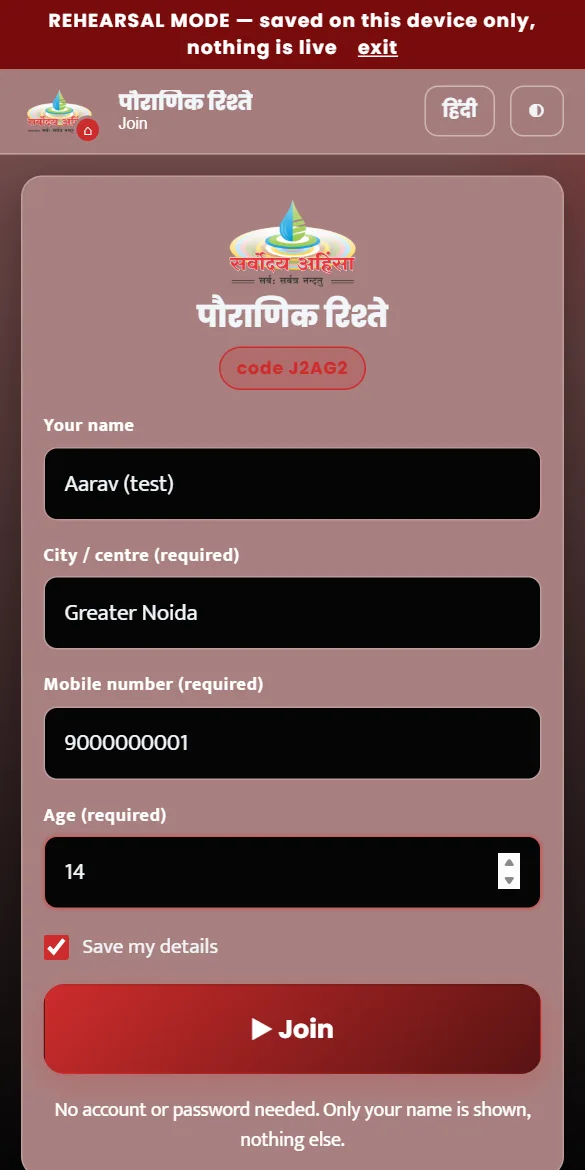
Phone screen: join a game with name, city, mobile number and age
Scene 2 · The host puts a 5-letter code on the projector
The idea

Put the game in every pocket.

Everyone in the hall already had a phone in their hand. So instead of a stage game, every round is played on phones, with the projector showing the question to the room.

Someone in row 12A code? No app to download? Name, city… okay, I'm in.
Audience member · said at the showआज कल सब वैसे ही मोबाईल में लागे रहते हैं आपने गेम्स को मोबाईल में डाल कर उसका अच्छा सदुपयोग कराया"Everyone is on their phone anyway. Putting the games on the phone made good use of it."
🧠
Meet people where they already are

Joining had to cost nothing: no app, no account, no password. A code, a name, and you're playing, in Hindi or English.
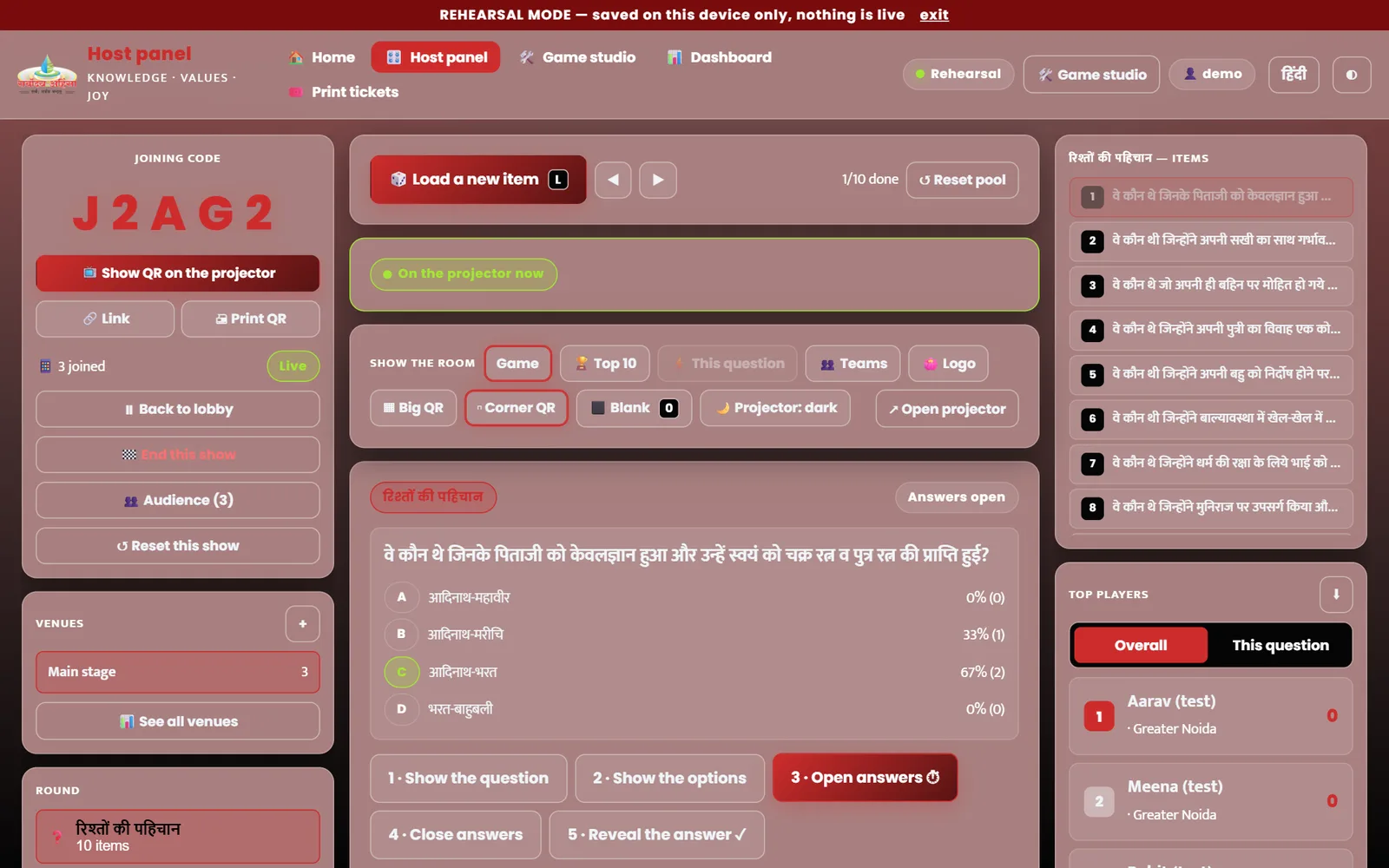
Host panel showing the five steps of a question and live answer counts
Scene 3 · Backstage, that's me
The build

One host, one laptop, three screens in sync.

MeFrom one panel I run the projector, every phone and the scoreboard: show → options → open → close → reveal. Each step has a key, so I can watch the hall instead of the laptop.

It grew into a platform: a game Studio with six game types, several venues at once, paper-and-phone tambola, Hindi and English, and an offline rehearsal mode. I built it with Claude as my engineering partner. The NGO has no tech budget, so it runs entirely on free services.

🧠
Cognitive load

A host on stage is already talking, timing and reading the room. The controls had to need almost no thought.
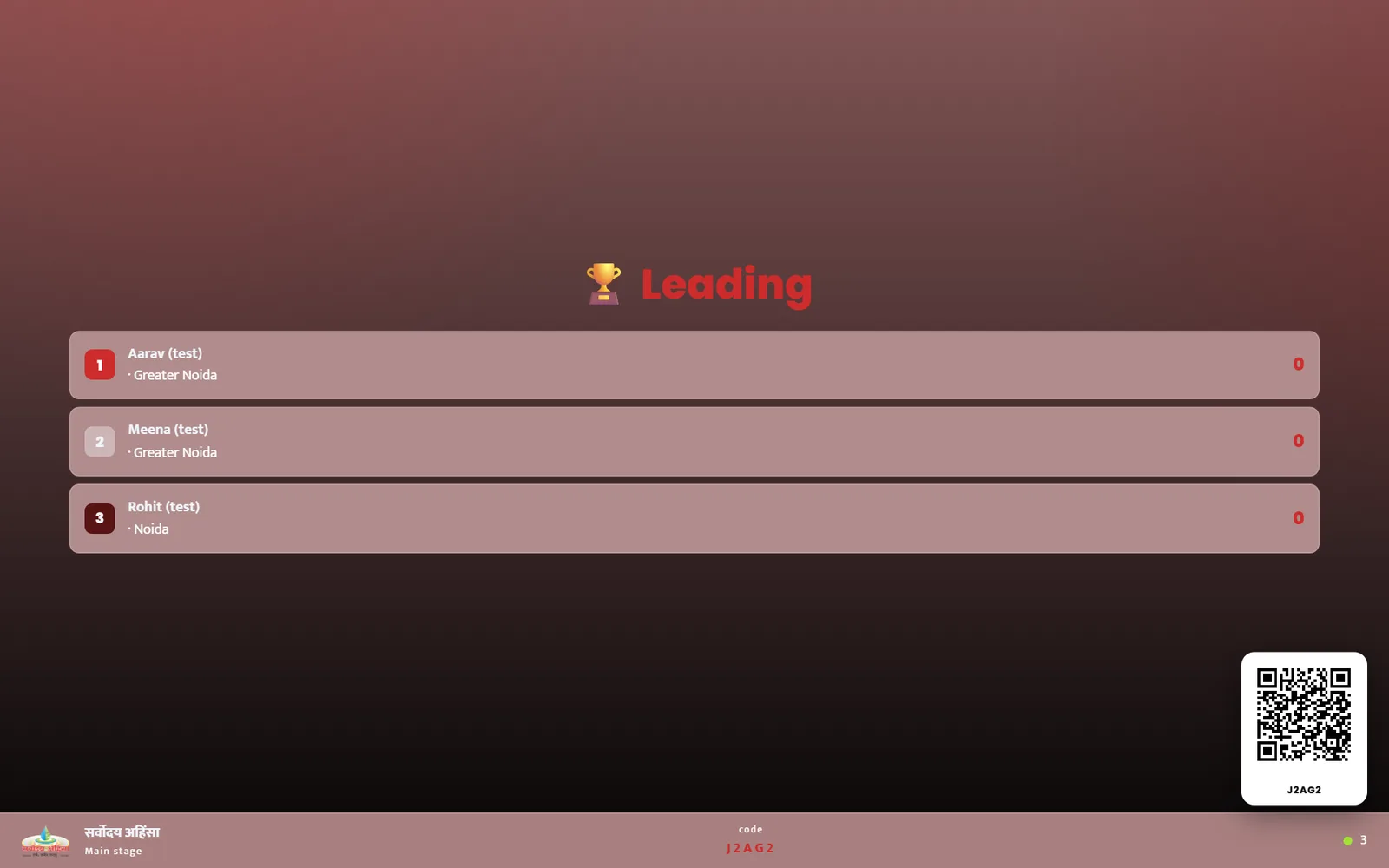
Projector showing the Top 10 leaderboard
Scene 4 · Three shows: 19, 20 and 25 September
Did it work?

The hall played.

83%of phones that joined answered (49 of 59), 19 Sep
89%answered (33 of 37), 25 Sep
~150people played across 3 shows
Audience member · said at the showअब हम लोग बोर नहीं हो रहे क्योंकि हम भी खेल पा रहे हैं इन गेम्स को।"We aren't bored any more, because we can play these games too."
Audience member · said at the showआपने स्टेज और ऑडियंस दोनों के लिए खेल का पार्ट बना दिया अच्छा लगा"You gave both the stage and the audience a part in the game."
LessonThe core bet worked. A hall that used to watch 4–5 people now plays from every phone.

What players typed vs. what counted

Anjana ✗Anjana ✗Bharat ✗Abhay ✗Dharma ✗
श्रेयांसनाथ ✗अभय कुमार ✗धर्म द्रव्य ✗
अंजना ✓भरत ✓अभय ✓धर्म ✓
Typed in English letters27
Longer correct form14
Spelling variant12
Genuinely wrong92
Scene 5 · The morning after the 19 Sep show
Plot twist

The scoreboard said 38%. It was wrong.

That show used typed answers. I went through every answer the system had marked wrong.

A player without a Hindi keyboardI typed "Anjana". That is the answer. Why does my phone say I'm wrong?
53 of 145"wrong" answers were actually right (37%)
38% → 61%what the screen showed vs. how well people really did
🧠
Perceived fairness

Nothing drains motivation faster than losing points you earned, and here it hit exactly the people we most wanted to include.
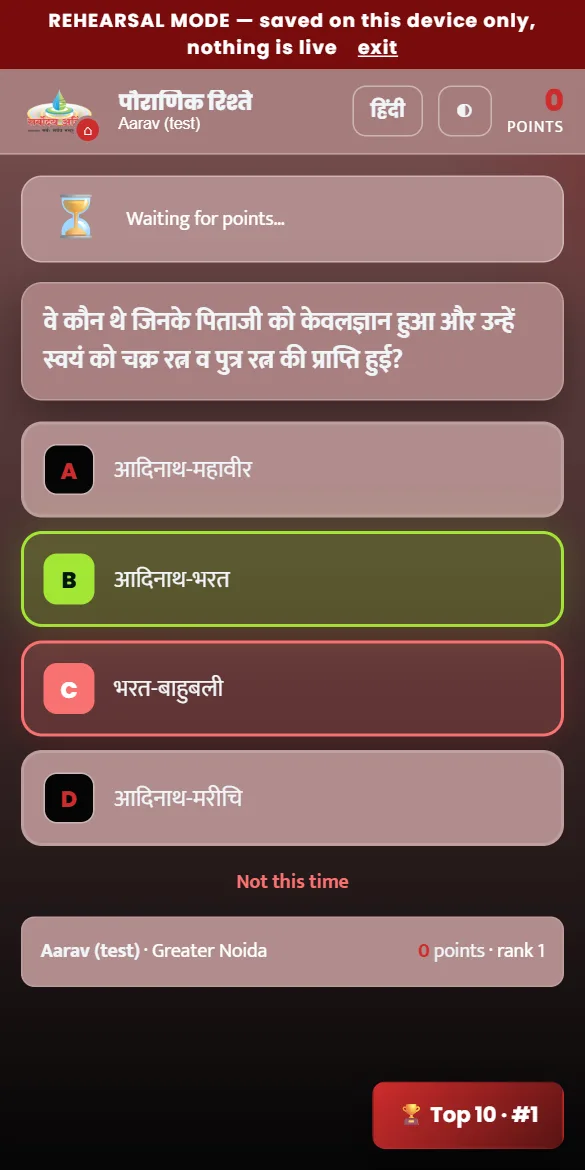
What I didFour days later I shipped spelling-tolerant matching and Roman-letter typing, which recovered 12 of the 53. The other 41 needed per-answer variants that nobody had time to write.
Phone after the answer is revealed: right or wrong and the player's rank
Scene 6 · Same shows, a quieter signal
Two more cracks

Some got bored. Nobody learned why.

An older audience member · said at the showआज की जनरेशन के लिए तो अच्छा है पर हम जैसे बूढ़े लोग थोड़ा बोर हो गए।"Good for today's generation, but older people like us got a little bored."

The data agreed. Two of the seven questions that night were answered correctly by just 1 person each, while another was answered correctly by 26 of 41. And after each reveal the phone said only right or wrong: 0 of 15 questions in that game had an explanation.

🧠
Flow

Too hard and people give up; too easy and their attention drifts. A hall aged 8 to 75 needs more than one difficulty, and the "why" after a reveal is where the teaching happens.

Four frictions, one root

Right answers marked wrongwhich spellings count?
One difficulty for every agehow hard is this question?
No "why" after the revealwhat's the explanation?
↓ all decided by ↓
Whoever writes the question:
me, the night before, ~1 hour by hand
Scene 7 · The night before a show
The real problem

One root under all of it.

MeEvery crack traced back to one moment: me, with a scanned granth, writing a show's questions by hand. About an hour each time. The writer decides the difficulty, the explanation and which spellings count, and I had time for none of it.
🧠
Fix the root, not the leaves

Three separate fixes would cost three times the effort. Changing how questions get written fixes all of them at once.
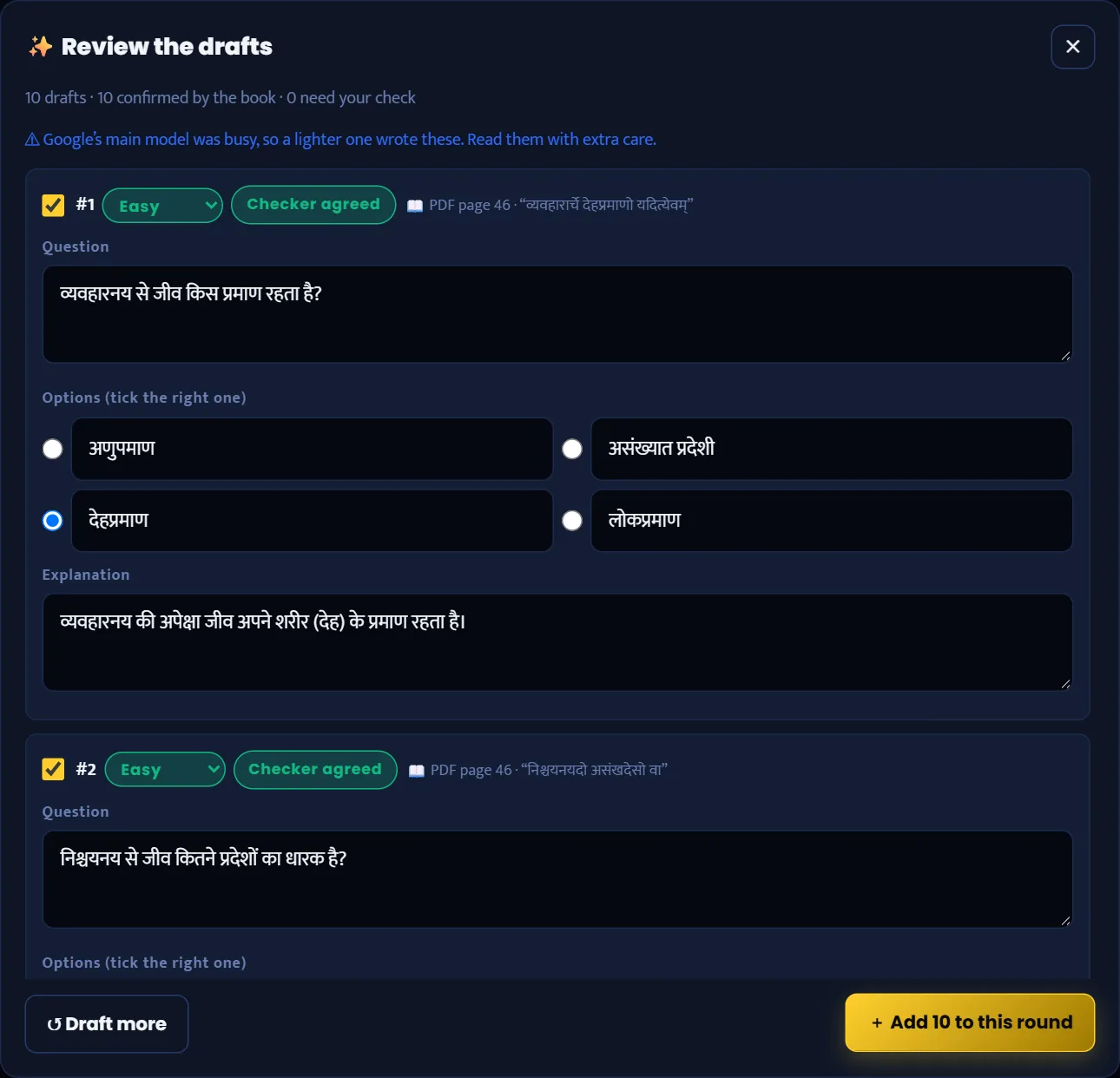
Review screen with AI-drafted questions, each with difficulty, checker verdict, page and quote
Scene 8 · Studio, Content tab, a new button: ✨ Draft with AI
The solution

What if I reviewed questions instead of writing them?

MeBook: बृहद् द्रव्य संग्रह. Pages 41–50. Four easy, four medium, two hard, please.
AI draft (Gemini) · real outputकुल कितने प्रकार के समुद्घात कहे गए हैं? → सात
Medium · PDF page 47 · with an explanation to read on stage
AI draft · typed answer · real outputAnswer जीव, and also accept: Jiva · Jeev · Jiv

Be the player with no Hindi keyboard

आठ प्रकार के ज्ञान और चार प्रकार के दर्शन का धारक तथा जिसमें प्राण होते हैं?
Try:
Before: exact match—
Now: spelling-tolerant + AI spellings—

"Ajeev" (अजीव) stays wrong. It means the opposite, so being tolerant must never mean being loose.

65 sfor 10 drafts (one real run)
~1 hrto write them by hand before
🧠
Recognition over recall

Judging a question is much easier than inventing one. The AI drafts; I recognise the good ones, fix or drop the rest, and nothing is added until I tick it.

Version 1 of the safety check

AI draftपुद्गल कर्मों का कर्त्ता तथा संसार के जीवों का सातवां नरक? → व्यवहार
Checker v1 (shown the answer)Is this supported by the book?
✓ Found in the book

Version 2: the blind check

Checker v2 (never sees the answer)Draft said आयु. My answers: ज्ञान / आयुष्कर्म
✗ Disagreed, left unticked
Scene 9 · Testing, 14 October
Plot twist #2

My first safety check agreed with nonsense.

This is religious teaching in front of children and elders, so a wrong "fact" on the projector is a real harm, not a typo. I added a second AI to check every draft. It approved a riddle whose two clues pointed to two different words.

MeShow a model an answer and ask "is this right?" and it tends to say yes. So now the checker answers every question blind, and my code compares the two answers. If they don't match, the draft arrives unticked.
🧠
Confirmation bias, in machines too

A reviewer who sees the answer first is looking for reasons to agree. Take the answer away and you get an independent opinion.
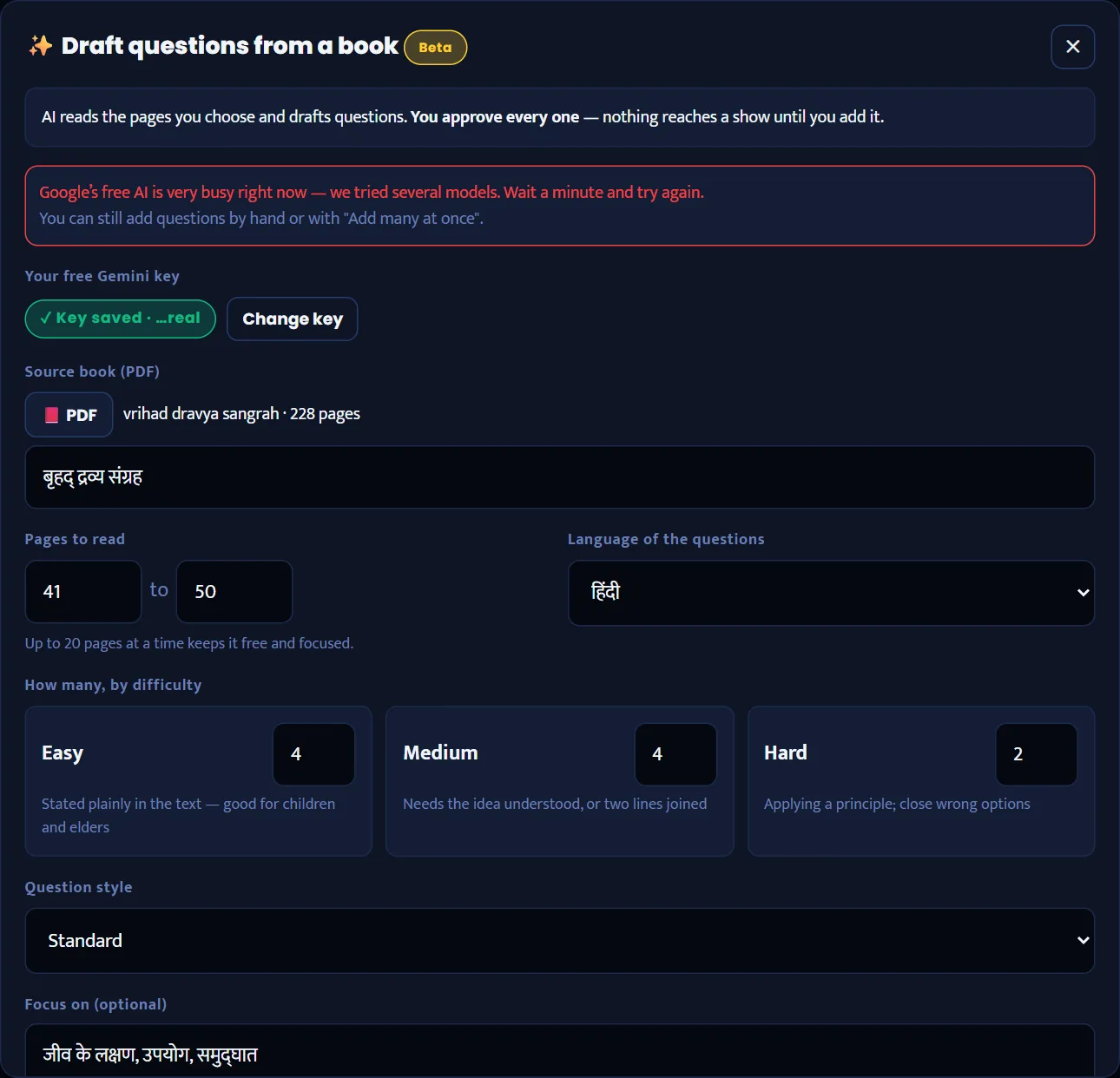
The AI dialog showing a clear message that Google's free AI is busy, with manual options
Scene 10 · Show-prep evening, Google is busy
Edge case

What if the AI isn't there?

In testing, Google's four newest models all replied "high demand", and one request hung for over three minutes. A show can't depend on someone else's server.

MeIt now walks through up to 8 free models, gives up on any that takes over 2 minutes, and if all are busy it says so plainly and points to manual entry. Your book and settings stay loaded.
🧠
Graceful degradation

When a part fails, the product should get a little worse, not stop. The manual path never depends on the AI. (The screenshot is from a deliberate outage test.)

North Star

AI-drafted questions that hosts approved and that were played in a live show, per month
60 → ≤ 15 minprep time per round
23% → < 5%right answers marked wrong
≥ 70%of drafts approved
easy ≥ 70%correct; hard ≤ 45%
Scene 11 · Now
What's next

Honest status, and how I'll know.

The AI feature has been live as a Beta in the Studio since 14 October 2026. It has not yet been used in a real show, so the numbers on the left are targets, not results. Next: three shows where every hall plays one AI round and one hand-written round, with my prep time measured, and a scholar checking every AI question before it reaches the projector.

🧠
Goodhart's law

Count what reaches the hall and teaches something, not how many drafts the AI produces. Otherwise the metric rewards volume nobody uses.

Go deeper

The full case study is six documents: evidence, PRD, risks, build, metrics and a stakeholder defence.

Player numbers come from the platform's own records and were aggregated without any personal data. Screenshots come from rehearsal mode with test players. Built with Claude (Anthropic) as my engineering partner. The problem, the decisions and the testing are mine.